They moved onto the island… and then they kept going. It was a beginning. But beyond it was the real test: a land that would demand not simple survival, but the shaping of something entirely new. Something that had never quite existed before.
The island was never meant to be the destination.
St. Clement’s was the threshold.
Within days of that first Mass, the settlers crossed the river again and began establishing their first permanent settlement along the shoreline that would become St. Mary’s City. If the island had been the place of arrival, this was the place where the dream would be tested, on land, in weather, in labor, and in the strained reality of human beings trying to live together.
From the water, the country must have looked almost impossibly rich.
The shoreline rose in long bands of forest. Oak and pine crowded the riverbanks. Spring was waking the land. The air bore the scent of wet ground and the smell of woodsmoke, and sunlight moved through the trees in broad, quiet shafts. After the brutal gray monotony of an Atlantic crossing, it must have come across as less like conquest than relief.
Here, at last, there was room to begin.
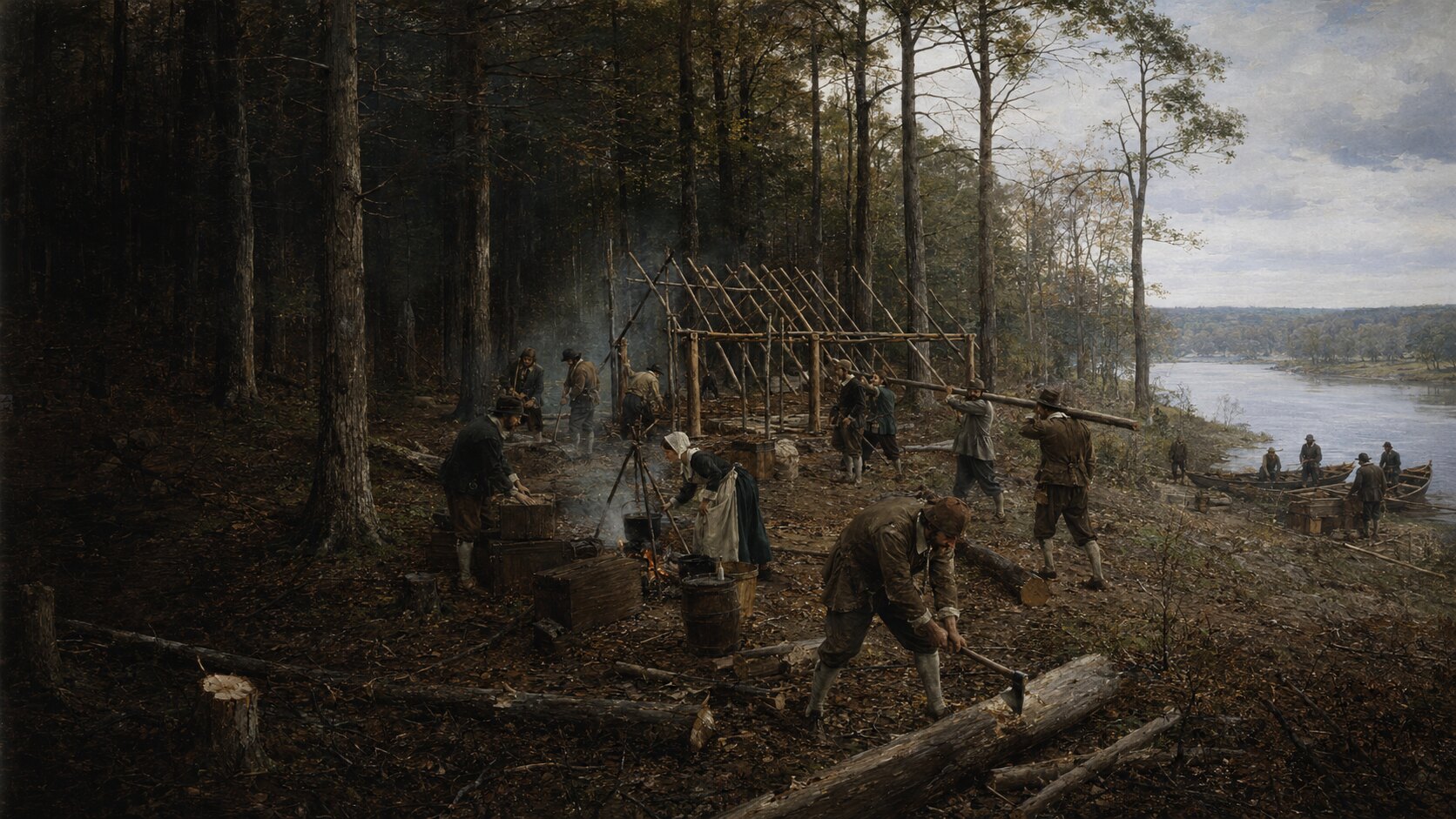
The settlers did not arrive in a finished world. They arrived in a wilderness that would have to be learned, negotiated with, and survived. Trees were felled. Rough structures rose along the shore. Smoke drifted upward through the forest canopy as cooking fires were lit, and the first rhythms of the settlement began to take hold. The sounds would have been ordinary enough: axes striking wood, hammers biting into timber, shouted instructions carried across the clearing.
And somewhere at the center of it all, the life of the Church began taking root as well.
For Father Andrew White, the first Mass on the island had not been a conclusion. It was a beginning. His mission now moved with the colony itself, into the woods, along the river, and into contact with a people and a landscape that were entirely new to the English settlers who had arrived there.
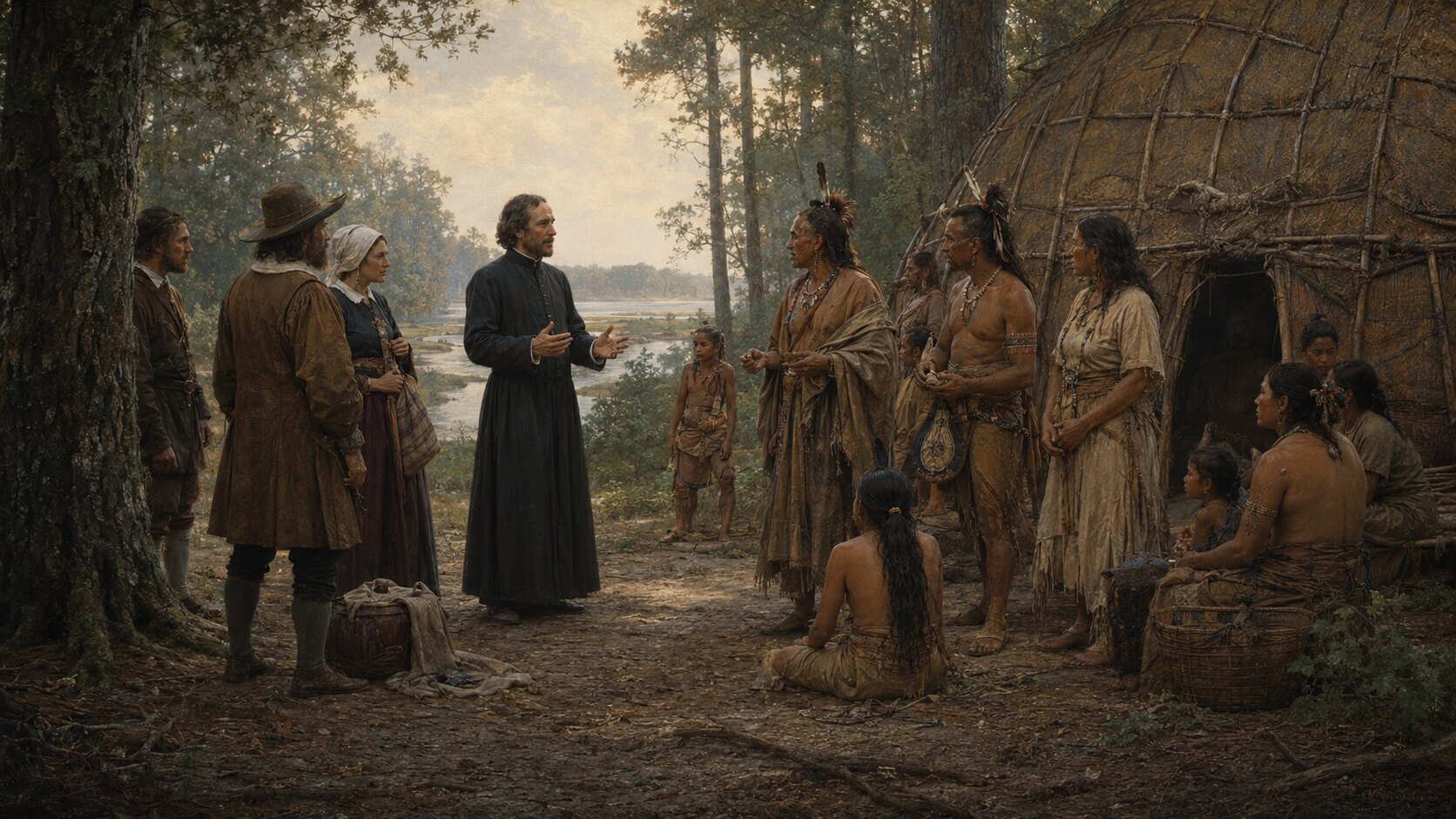
The land that would become Maryland was not empty. It already belonged to others, and in those first months the survival of the colony depended in no small part on the Yaocomico and other Native peoples who understood the region far better than the newcomers ever could. They knew the waterways, the seasons, the habits of the land. They knew what could be planted, where fish could be found, how weather moved through the river country, and how a settlement might survive where a stranger could easily be engulfed by ignorance.
For a time, at least, the relationship was defined more by cooperation than by conflict. Land was negotiated. Knowledge was exchanged. The colony took shape in the uneasy but necessary reality that no one builds anything lasting alone.
And White, for his part, did what missionaries have always done when they take their faith seriously enough to bring it to the edge of the known world.
He began to learn.
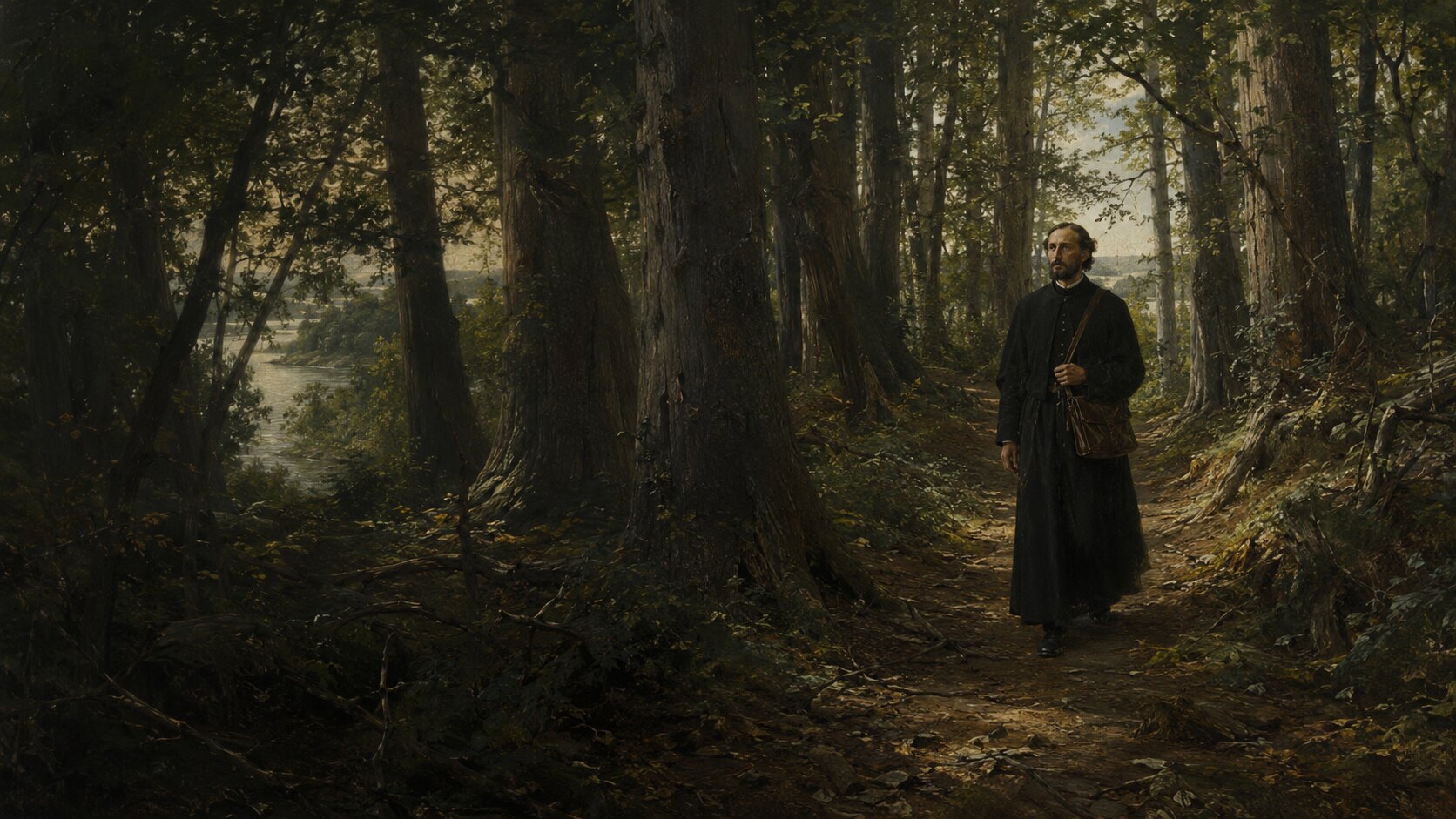
He traveled the forest paths beneath the tall trees. He listened. He studied languages. He spoke with Native leaders. He carried the faith not as a theory, but as something embodied, in prayer, in presence, and in the slow work of building trust within a world not his own.
It is one thing to write the phrase religious liberty from the comfort of hindsight. It is another thing to picture what the beginnings of that idea actually looked like.
It looked like rough timber and mud.
It looked like river water and variable weather.
It looked like a priest carrying the things necessary for Mass into a terrain where there were no church bells yet, no chapels, no certainty that any of it would last.
And still, the Mass continued.
At first, it would have been celebrated in the simplest of settings, in makeshift spaces, in rooms barely fit for purpose, perhaps beneath open sky when necessary. In time, those fragile beginnings gave way to something more stable: a chapel, humble but real, rising among the trees.
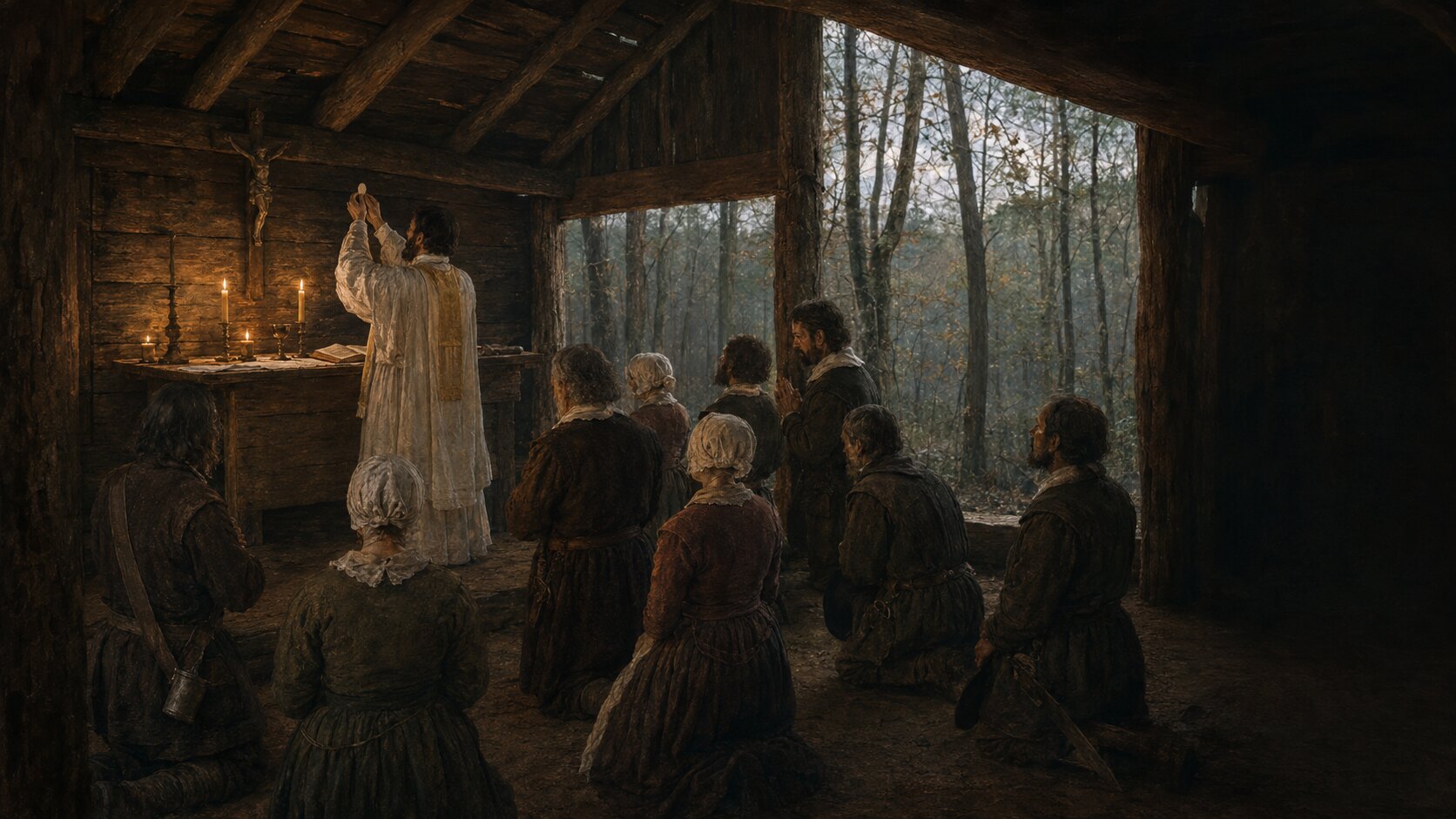
And that’s a detail often lost to the sands of time…
Because freedom is often spoken of in grand words, in declarations, constitutions, courts, and political speeches. But before it is ever written into law, it is usually lived in small and vulnerable places first. It has to survive as practice before it can endure as principle.
And here, in the early years of Maryland, that was exactly what was happening.
For the first time in generations, English Catholics could practice their faith openly in a place that belonged to the English world. No hidden embassy chapel. No hushed prayers behind closed doors. No anxious glance toward the door as the liturgy began.
Here, the faith could breathe.
That doesn’t mean the colony was some kind of holy utopia. It wasn’t. Maryland was still a colonial venture, still formed by the ambitions, blind spots, compromises, and power struggles that attach themselves to every human project. Catholics and Protestants did not suddenly become immune to suspicion simply because they had traversed an ocean. And even in its best moments, the experiment remained vulnerable.
But vulnerable is not the same thing as false.
Because what took root along these rivers wasn’t perfection. It was possibility.
A colony where Catholics and Protestants might, however imperfectly, occupy the same civic space without immediately trying to extinguish one another. A place where the old reflexes of persecution, so firmly rooted in Europe, might loosen their grip just enough for something new to emerge.
The idea had not appeared out of nowhere.
It had been carried here through secrecy and failure.
Through George Calvert’s conversion in England, where to become Catholic had meant forfeiting power and accepting risk. Through the punishing failure of Avalon, where the dream became nearly frozen to death along the Newfoundland coast. Through the planning of his son Cecil Calvert, who understood that if this second attempt was to survive, it would have to be more than a Catholic refuge. It would have to be broad enough to hold difference without collapsing under it.
That was the gamble.
Not simply whether a colony could be planted.
But whether a people divided by fear and theology could live near one another without recreating the same old violence of the old world.
And for a little while, it seemed they might.
Ships arrived carrying supplies and new settlers. Homes multiplied. Fields spread farther into the forest. Children were born who would never know England except as a story told by their parents. A local Catholic life began to acquire the shape all Catholic life eventually acquires when it settles in one place: prayer, work, meals, marriages, baptisms, ordinary suffering, and the steady return of Sunday.
What once had survived in England as a hunted faith was now becoming visible, even ordinary.
That may be one of the most powerful things about the story, and one of the easiest to miss.
Because once the extraordinary becomes ordinary, it stops drawing attention to itself.
A Mass said openly.
A child learning prayers without fear.
A community gathering in peace.
Those things can seem small.
Until you remember how hard they once were….
And that, I think, is part of what makes Maryland’s beginning so profound. Not that it solved the problem of religious conflict. It didn’t. The old tensions were still alive, and before long they would reassert themselves with painful force. The experiment might fracture. The dream would be wounded. The Mass itself would again be driven toward silence.
But for a moment, for one brief, luminous stretch of history, faith had found room to breathe in the open air.
That matters not because it was complete, but because it was born.
The older I get, the more I am drawn to these times in history that did not arrive polished and triumphant. The times that were partial. Fragile. Human. The times that could have failed and often nearly did.
Maybe that’s because Grace itself so often works that way.
Silently.
Without spectacle.
Through weak vessels.
A cross on an island.
A rough chapel in the woods.
A priest walking a forest path.
A handful of settlers trying, however imperfectly, to begin again.
When I return in my mind to St. Clement’s Island, I don’t only think about the first Mass. I think about what came after it. Boats crossing the river to the mainland. Smoke rising through the trees at St. Mary’s. The sound of axes, the smell of salt air, the prayers of a people who had not yet the luxury of taking any of it for granted.
This is where the project gets its real force.
Not simply in the fact that the first Mass was celebrated.
But in what that Mass made possible.
A settlement.
A mission.
A fragile social experiment.
And, however faintly at first, the beginning of an idea that would long outlive the generation that first carried it ashore.
An idea that still had storms ahead.
But an idea that had finally, unmistakably, found land.